Port Hope Downtown Historical Buildings and Landmarks
Compiled by: Jason Kay
Hike references: various

Overview
The settlement of Port Hope was ostensibly a reaction to the American Revolution. Until the Americans had defeated the British, the region was mostly populated by First Nations people, who had been granted exclusive rights to the north shore of Lake Ontario by the British.
Out of fear of U.S. expansion into Canada, the Brits negotiated the Gun (or Gunshot) Treaty in the early 1790s, which opened land for settlement on the north shore of Lake Ontario, from the Bay of Quinte to Toronto. It was called the Gun Treaty because it covered a distance from which a gunshot could be heard.
Roughly 40 families initially settled near the Ganaraska River, which was appealing as a waterway and as a source of power for grist and sawmills. In the 1790s, Hope Township was established by Governor Simcoe and named for Henry Hope, a one-time lieutenant-governor of Lower Canada and a prominent military figure in the 1780s.
The town of Port Hope was incorporated in 1834 and over the next several decades there was a population and prosperity boom, a period during which many of the historic buildings and stately houses were built. The main sources of revenue were the exports of timber, whiskey and grain. The area also became a popular location of the construction of summer homes by wealthy Americans.
Port Hope P.S.: The Huron named the river the “Ganaraske”, which translates to “spawning ground”.
Notable Buildings, Landmarks and Points of Interest
Town Hall, 56 Queen St. (1851-1853, rebuilt 1894): Construction on the original Town Hall began in 1851 and took two years to complete. It featured council chambers and a courthouse on the upper floor and a market and civic centre on the lower floor. The building was gutted by fire in 1893 and rebuilt in 1894. The new structure boasted the tower clock and a steeper roof. The covered market was also removed for the rebuild. From 1908 to 1940, a man named Chester Arthur and his family lived in an apartment on the main floor. Arthur was the tax collector, a police constable and a maintenance man.

Port Hope P.S.: Prominent guests to Town Hall included the Prince of Wales and future King Edward VII (1860), Princess Louise, one of Queen Victoria’s children (1879), and Prime Minister Sir John A. MacDonald (1889).
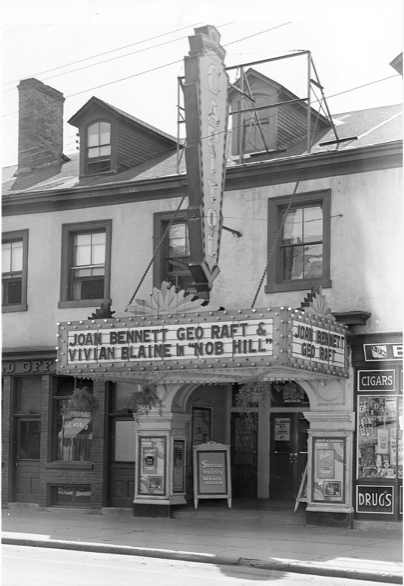
Capitol Theatre, 20 Queen St. (1930, restored 1995): Now a designated national heritage site, the Capitol opened as a cutting-edge talking picture movie house in 1930. It had been commissioned by Famous Players following the closure of the town’s previous theatre, the Opera House. The Capitol is considered a rare example of an “atmospheric theatre”. The interior is designed to resemble a medieval courtyard under a starry sky. By 1987, the theatre had fallen on hard times and shuttered its doors. A group of local citizens organized to restore and revive it, and the building was re-opened in 1995. Due to its history and unique attributes, it earned its national heritage site designation in 2016.
Port Hope P.S.: The opening night film at the Capitol in 1930 was a musical called “Queen High”, starring Ginger Rogers.
Hotel Carlyle, 86 John St. (1857): It started as a bank, became a dairy, has been a private residence and is now the inn and restaurant we are familiar with today. Its builder and first inhabitant was the First Bank of Upper Canada, who ran the operation of the main floor; the upper floors were used as a residence for the bank manager. In 1881, it was purchased as a private residence by Dr. Robert A. Corbett. He is known for overseeing the construction of Corbett’s Dam and powerhouse, which produced the first electricity for Port Hope. By 1920, it had become the Port Hope City Dairy, then subsequently passed through several owners until it was purchased and converted into a hotel/restaurant in 1985.

Port Hope P.S.: The old bank vault is now a dining room and the inn has 10 guest rooms.
The Ganaraska Hotel/“The Ganny", 30 Ontario St. (1837): The famous/infamous dive bar began its existence in 1837 as The Railroad Hotel. The tracks of the Midland Railway ran along Lent Lane, down what is now Ontario Street and past The Ganny. It’s possible the building also doubled as a ticket office for the rail line. The property passed through several owners and experienced a handful of name changes over the years. These include Matthew’s Hotel, Lambert’s Hotel, Bennett’s House and Ontario House. It became The Ganaraska Hotel in 1947. For many years, the bar only served beer and was divided into a men’s and ladies/escorts side until 1976. The Ganny withstood a barrage of flood water during the 1980 local disaster. Five feet of water rushed through the alleyway beside the building, washing a pickup truck into the structure across the street. The bar re-opened 10 days after the flood.

Port Hope P.S.: The train tracks that ran past The Ganny were removed in the 1980s.
Port Hope Public Library, 31 Queen St. (1913): The building at 31 Queen Street began as a Carnegie Free Library – it was one of roughly 2,500 Carnegie Free Libraries on the planet, and one of about 125 in Canada. (Scottish-American philanthropist Andrew Carnegie provided grants for the construction of admission-free libraries to various nations between 1883 and 1929). Prior to this, libraries were mostly fee-based, including Port Hope’s first library, named the Mechanics’ Institute, which opened on Walton Street in 1852. The Queen Street library has undergone some renovations and expansions, most notably in 1971 and 2001. The 2001 renovation saw the facility double in size and undergo restorations to make it more closely resemble the original structure. It was renamed the Mary J. Benson branch of the Port Hope Library. A second branch, in Garden Hill, became part of the Port Hope network when the town and Hope Township amalgamated in 2001. The Mary J. Benson Building celebrated its 100th anniversary in 2012.

Port Hope P.S.: The library is one of downtown Port Hope’s few historical buildings that was not gutted by fire.
Queen’s Hotel/Walton Hotel, 81 Walton Street (1871): Built as an upscale, first-class hotel it was said to be “without rival” between Toronto and Belleville. It boasted 50 guest rooms, steam heat, an elegant dining room, hot and cold water and telephone connections. Prior to its opening, the location had been home to several other hotels, dating to 1802 (Jacob Choate’s “The Caldwell Hotel”). The Caldwell was succeeded by Strong’s Coffee Exchange House, Thompson’s Hotel, the William Rowlands Hotel and finally the Durham House, which was gutted by fire in 1859. The Queen’s was initially a two-storey structure in 1871; a third was added in 1876. The building passed through a series of owners in the ensuing decades and some retail space was added on the south side, featuring a variety of businesses. Infamously, in 1978, a member of the Golden Hawk biker gang (Bill Matiyek) was shot and murdered by members of the Satan’s Choice gang. Six of eight people charged with the murder were convicted. The hotel’s name was changed to The Walton following the slaying, and it operated as a tavern until 2005.

Port Hope P.S.: Port Hope has 260 designated heritage properties, the largest per capita number in Canada.

Opera House Block, 85 Walton Street (1871): Built by brothers James and Richard O’Neill, two dry goods merchants, the Opera House was a music hall and entertainment facility. The hall consisted of an 82’x45’ room, with a large dais at one end that served as a stage, and it did not have a gallery. It hosted theatrical productions, concerts, lectures and for a time, films. The O’Neills went bankrupt and the property passed through a few hands before being purchased by the Royal Bank of Canada in 1912. The bank operated there until 2016. The building was subsequently purchased and, as of 2026, was undergoing a significant restoration.
Port Hope P.S.: Before the Opera House opened, performances, concerts and lectures in Port Hope were held in Town Hall.
Farley Mowat Monument & 25 John Street (1850s): Farley Mowat, the famous Canadian author and environmentalist, moved to Port Hope in 1967. In 1968, he purchased the property known as Meredith House at 25 John Street and lived there for a period of time. The roofed boat-house monument was built in 2006. Made from 30 tons of limestone, it is inspired by a house mentioned in Mowat’s 1998 book, “The Farfarers”. Mowat surmised that very early travellers crossing the Atlantic from the British Isles turned their boats over for shelter on dry land. The monument was initially located on private property in Port Hope (20 Caroline Street) and moved to the east side of the Ganaraska River for greater public access in 2016.

Port Hope P.S.: Mowat, whose first book “People of the Deer” was published in 1952, wrote 42 books in all. Born in Belleville, Ont., in 1921, he lived in Port Hope from 1967 until his death in 2014.
Memorial Park Bandshell (1946): The venue was built as a memorial to local armed service personnel who had fought since Confederation in 1867. It subsequently has come to represent all who served in wars. It was designated a Heritage Property in 1992. Its design was based on blueprints from the Canadian Bandmasters' Association, which provided a model with "the most up-to-date scientific principles of sound technology.”

Port Hope P.S.: The bandshell was originally located behind Town Hall, but was restored and relocated to Memorial Park in 1992.
The Smith Block, 34-36 Walton Street (1850): The original Smith Block, erected by Elias Peter Smith in 1844, burned to the ground in 1850 and was promptly re-built. The new structure housed a series of businesses until it also was ravaged by fire, in 1980, just two months after that year’s disastrous flood. The owner had intended to demolish the building, but locals Anita Blackwood and A.K. Sculthorpe secured funding to help save the facade. The two women are credited with beginning a revived movement to maintain Port Hope’s architectural history. Blackwood was the wife and business manager of celebrated Canadian artists David Blackwood. Alice King (A.K.) Sculthorpe was a conservationist and heritage building advocate, who has a woodland marsh named in her honour on the east side of Port Hope.

Port Hope P.S.: Walton Street was named the province’s “Best Preserved Main Street” by TV Ontario.


Comments