Presqu'ile Provincial Park
- Shelley Irving
- May 1
- 3 min read
Submitted by: Shelley Irving
Hike Reference: 12.5 km Presqu'ile Provincial Park

(Notes and highlights about the hike at Presqu’ile, sourced from the following websites: Presqu’ile Park; Friends of Presqu’ile; and the Wikipedia page about Presqu’ile.)
History
The name, "presquille", is French for peninsula, or literally "almost an island". The peninsula was formed when a limestone island was connected to the mainland by a beach formation.
The park area had been selected in 1797 as the site of a town called Newcastle, which was to become the county seat. However, on Oct. 8, 1804, the schooner HMS Speedy, which was bringing officials to a trial at the new courthouse, sank offshore with all on board lost. The ship was never found, nor the bodies of the passengers and crew. The county seat was moved to nearby Amherst (now Cobourg).
The lighthouse. In 1840, a lighthouse was completed at Presqu'ile Point. The designer of the 69-foot, octagonal structure was Nicol Hugh Baird. Baird also designed the Murray Canal, parts of the Trent-Severn Waterway and the Rideau Canal. Today, this lighthouse stands as the second oldest operating lighthouse on the north shore of Lake Ontario.
Provincial park established. In 1922, a private commission was given authority to develop a park at Presqu'ile. In the 20th century, Presqu'ile became popular for recreation, with two kms of sandy beaches, a summer hotel and dance pavilion, an annual regatta race, a nine-hole golf course and opportunities for boating. As the decades passed, the type of recreation enjoyed at the park changed, which caused the dismantling of the golf course and the closure of the hotel and dance pavilion. Presqu'ile was incorporated into the Ontario Parks system in 1954 and has become a popular destination for campers, naturalists, and other users.
Singing frogs at Beach 2. This chorus starts in early spring with Chorus Frogs singing dependent on the seasonal flood and moist sand, similar to a wet meadow. (Pannes). They start singing anytime between mid-March and early April depending on the thaw. They are soon joined by Spring Peepers and in lesser amounts by Leopard Frogs and Wood Frogs. By May, American Toads and Grey Tree Frogs have chimed in.
Seasonal floods, wetlands and dunes. The dunes and wetlands arise out of natural processes, such as the high and lower water periods in the Great Lakes. Both the area of wetlands, and the number of plant species in them, depends upon a combination of high water and low water over decades. The park has one of the larger wetlands along the north shore of Lake Ontario. Sand dunes and pannes are uncommon along the north shore of lake Ontario.
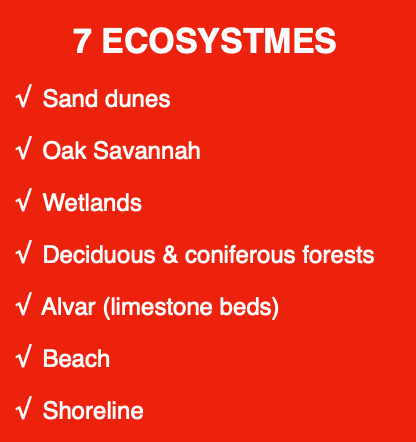
Seven distinct ecosystems. Sand dunes, oak Savannah, wetlands, deciduous and coniferous forests, Alvar (limestone beds), beach and shoreline. These ecosystems make Presqu'ile a highly diverse and ecologically significant area.
Gull island and high bluff. These are breeding grounds for various bird species. In particular the Caspian Tern is the largest breeding colony in Ontario. Great Egrets and night herons have been recorded nesting on the high bluff island. To protect sensitive species, the islands are restricted from March 10 to Sept. 10 each year.
Migrating birds. The park's location on Lake Ontario makes it a perfect stop over for migrating birds and for viewing opportunities. The park's long beaches make it appealing to migrating shorebirds in early spring, and Presqu'ile Bay is an important staging area for thousands of these birds. Presqu'ile has been identified as a Canadian Important Bird Area
The marsh. The has a large marsh which provides nesting habitat for other wetland birds. There are forested areas and open fields; a wide variety of habitats in a relatively small park.
White-tailed deer. There is a fairly substantial population of white-tailed deer, whose grazing is doing significant damage to native plants in general, and to tree regeneration in particular. Other concerns are invasive plant species such as strangling vine and grasses.
Turtle protectors. Park staff and “Friends of Presqu’ile” have engaged in various initiatives to help protect the turtle population. These include ecopassages (wildlife underpasses), fencing and artificial nesting mounds. During their nesting season in June, turtles tend to select gravel or sandy areas such as road shoulders. Only 2% of the hatchlings make it to adulthood. Predators such as skunks, fox and raccoons often destroy nests within 12 hours. Presqu’ile is home to five turtle species, including the common snapping turtle and the Midland painted turtle. All are considered endangered species.


Comments